A. Differences Between Various Types of Motors
1. DC and AC motors
Power Source:
DC Motor: Uses direct current (DC) as the power source.
AC Motor: Uses alternating current (AC) as the power source.
Principle and Structure:
DC Motor: Simple principle but complex structure, requires brushes and commutators, making maintenance difficult.
AC Motor: More complex principle but simpler structure, easier to maintain.
Cost:
DC Motor: Typically more expensive for the same power rating, including higher costs for speed control devices.
AC Motor: Generally lower cost, with more complex speed control systems, but cheaper maintenance and simpler structure, leading to lower long-term usage costs.
Performance:
DC Motor: Offers higher speed stability and precise speed control, ideal for applications requiring strict speed control and high precision.
AC Motor: While speed control is more complex, AC motors are widely used in industrial applications, especially in chemical plants and places requiring stable AC power.
Conclusion:
Choosing between DC and AC motors depends on specific application requirements, such as control precision, maintenance costs, and price factors.
2. Synchronous and Asynchronous Motors:
Synchronous Motor: The rotor speed is equal to the stator speed.
Asynchronous Motor: The rotor speed is not equal to the stator speed.
3. Standard and Variable Frequency Motors:
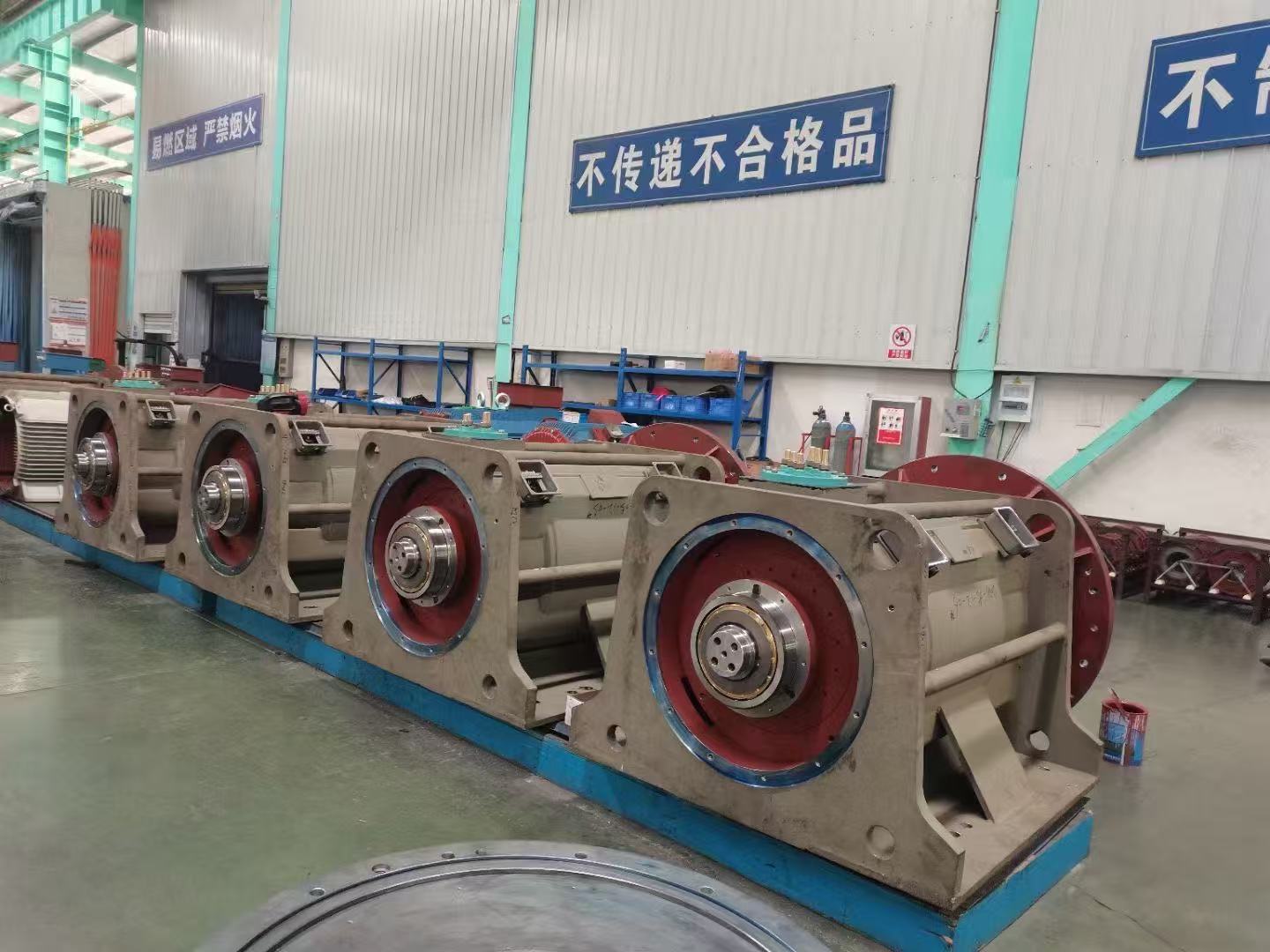
Standard Motor: Designed to operate with a constant frequency and voltage, and cannot fully adapt to the speed control requirements of a variable frequency drive (VFD). Therefore, it cannot be used as a variable frequency motor.
Variable Frequency Motor: Specifically designed to work with variable frequency drives (VFDs), allowing for adjustable speed control.
Power Source Compatibility
Standard Motor: Designed to operate with a constant frequency and voltage, suitable for direct connection to the standard power grid, and does not support variable frequency speed control.
Variable Frequency Motor: Specifically designed to work with a variable frequency drive (VFD), capable of adapting to frequency changes, and supports variable frequency speed control.
Performance Parameters
Standard Motor: The speed is synchronized with the grid frequency, operating at a constant speed, making speed control difficult.
Variable Frequency Motor: Can operate over a wide range of speeds, suitable for applications that require speed control.
Insulation System
Standard Motor: Insulation design mainly considers power transmission at a constant frequency and may not be suitable for high-frequency variations.
Variable Frequency Motor: Features specialized insulation capable of withstanding high-frequency voltage pulses, with more durable insulation materials for the stator and rotor windings.Variable frequency motors usually have insulation classes of F or higher, with reinforced ground insulation and winding insulation strength to handle surge voltages.
Winding Design
Standard Motor: Winding design is suitable for a constant-frequency power source, typically used for constant-speed operation.
Variable Frequency Motor: Winding design is optimized to handle current fluctuations caused by high-frequency changes, preventing additional losses from high-order harmonics and enhancing adaptability to frequency variations.
Cooling System
Standard Motor: Cooling system usually relies on a specific operating speed.
Variable Frequency Motor: Variable frequency motors typically use forced ventilation cooling, with the cooling fan driven by a separate motor to ensure continuous heat dissipation.
Structural Reinforcement
Standard Motor: Relatively simple structure, suitable for applications with constant frequency.
Variable Frequency Motor: To adapt to non-sinusoidal current provided by the VFD, it typically has enhanced structural strength, including improved rotor and stator bearing capacity, increased resistance to vibration, and better electromagnetic interference tolerance.
Vibration and Noise Requirements
Variable frequency motors require careful consideration of component and overall motor rigidity, increasing their natural frequency to avoid resonance with force waves generated by VFDs.
Protection Measures
For motors over 160kW, bearing insulation is required to prevent bearing damage caused by shaft currents, especially when combined with high-frequency components. Special lubricants resistant to high temperatures should be used for constant-power motors when speeds exceed 3000 RPM to mitigate bearing temperature rise.
In summary, the main differences between standard motors and variable frequency motors lie in their power source compatibility, structural design, insulation systems, winding designs, and cooling methods. Variable frequency motors require more advanced design considerations to handle the frequency variations and non-sinusoidal currents produced by VFDs.
B.The impact of a variable frequency drive (VFD) on a motor mainly affects its efficiency and temperature rise.
1.Harmonic Voltage and Current: During operation, a VFD generates varying degrees of harmonic voltages and currents, causing the motor to run under non-sinusoidal voltage and current conditions. The high-order harmonics result in increased losses in the stator copper loss, rotor copper loss, iron loss, and additional losses.
2.Rotor Copper Loss: The most significant impact is on rotor copper loss, which causes additional heating in the motor, reduces efficiency, and decreases output power. Typically, the temperature rise in standard motors increases by 10-20% when powered by a VFD.
3.Voltage Rise Rate :The carrier frequency of a VFD ranges from several kilohertz to tens of kilohertz, causing the stator windings to endure high voltage rise rates. This is equivalent to applying a sharp voltage shock to the motor, putting considerable stress on the motor’s inter-turn insulation.
4.Vibration and Noise: When a standard motor is powered by a VFD, the vibration and noise caused by electromagnetic, mechanical, and ventilation factors become more complex. Harmonics in the VFD interfere with the motor's inherent spatial harmonics, resulting in electromagnetic excitation forces that increase noise levels.
5.Cooling and Efficiency: As the motor's operating frequency range and speed change, the frequency of electromagnetic forces can often coincide with the motor's structural natural frequencies, leading to amplified vibrations. When the motor speed decreases (due to a lower VFD frequency), the cooling airflow, which is proportional to the cube of the speed, decreases significantly, resulting in poor heat dissipation. This causes a sharp increase in temperature rise and difficulty in maintaining constant torque output.
In summary, using a VFD with a standard motor can lead to increased losses, higher temperature rise, and more complex vibration and noise issues. The motor may also face challenges in maintaining constant torque at lower speeds due to reduced cooling efficiency.